
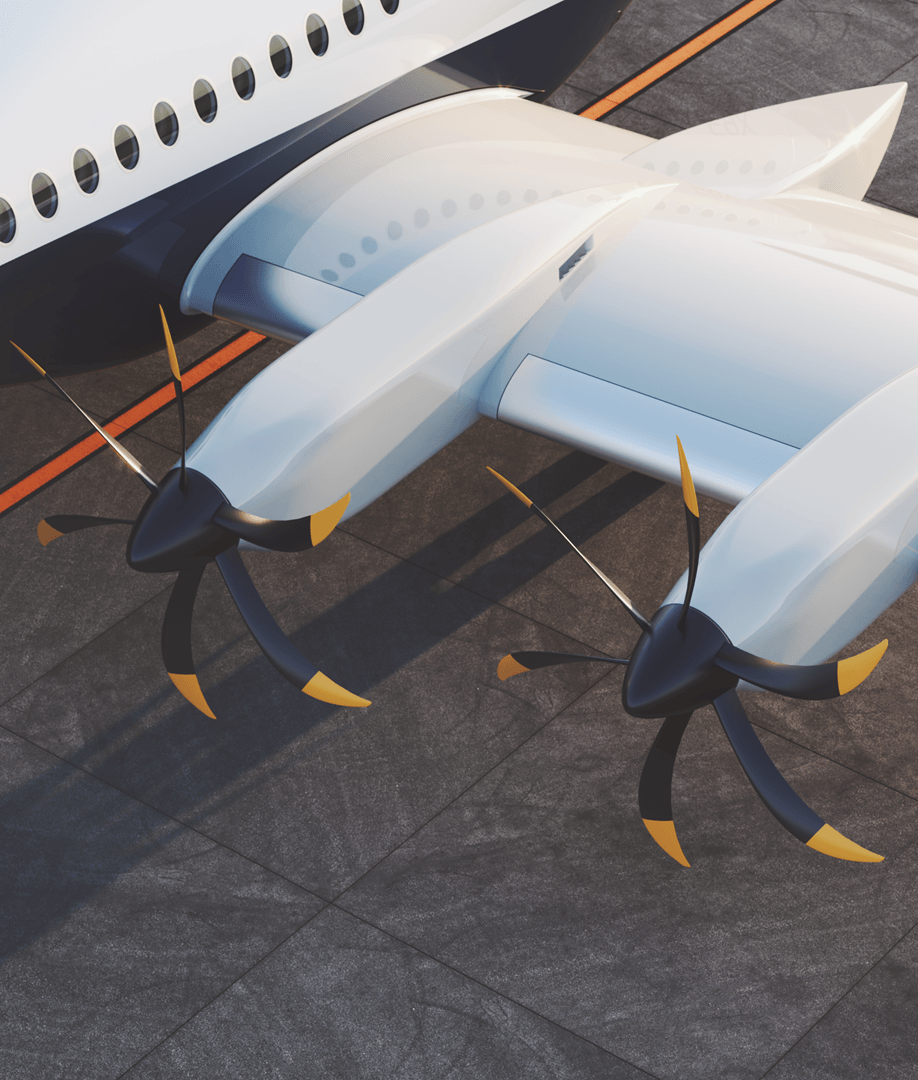
Aviation's transition to electric starts here.

E9X provides a scientific foundation, design blueprint, and economic proof points to make that transition possible.

The most efficient path to zero-emission aviation. 
Battery-electric propulsion delivers the highest energy efficiency of any aviation technology. Fewer conversion steps. Less energy lost. More range from every kilowatt-hour.

Battery Electric

- 18%
Energy Loss
82%
Usable Energy
Key Loss Steps

Eg. well-to-tank and tank-to-wake loss

  • Grid transport loss
  • Battery charging and discharging
  • Electric motor efficiency loss

Hydrogen Fuel Cell

- 65%
Energy Loss
35%
Usable Energy
Key Loss Steps

Eg. well-to-tank and tank-to-wake loss

  • Hydrogen production (electrolysis)
  • Hydrogen liquefaction
  • Grid transport loss
  • Fuel cell conversion loss
  • Electric motor efficiency loss

Hydrogen Turbine

- 76%
Energy Loss
24%
Usable Energy
Key Loss Steps

Eg. well-to-tank and tank-to-wake loss

  • Hydrogen production (electrolysis)
  • Hydrogen liquefaction
  • Grid transport loss
  • Fuel cell conversion loss

E-SAF

- 81%
Energy Loss
19%
Usable Energy
Key Loss Steps

Eg. well-to-tank and tank-to-wake loss

  • Hydrogen production (electrolysis)
  • CO₂ direct air capture efficiency loss
  • E-SAF synthesis efficiency loss
  • Grid transport loss
  • Turbine combustion efficiency loss

Fewer conversion steps. Less energy lost. More range for every kilowatt-hour.

The lowest climate impact in aviation.

E9X delivers the lowest total climate footprint across every time horizon.
2035: The lowest impact of any aircraft type.
2050: Near-zero climate impact with renewable energy grids.
Electric aircraft outperform hydrogen, SAF, and conventional propulsion in every scenario.


Impact in gCO₂ equivalent per passenger kilometer

      Zero-emission flight is not a goal. It is a trajectory.

      The strongest economic case in its class.
      Battery-electric aircraft reduces costs through energy efficiency and mechanical simplicity. Lower energy cost. Lower maintenance. Fewer moving parts. Total operating cost is lower than any comparable technology.
      Battery Electric
      Hydrogen Fuel Cell
      Hydrogen Turbine
      E-SAF
      Energy Fuel* Cost
      Low**
      Medium
      Medium
      High
      Maintenance Cost
      Low
      Medium
      High
      High
      Other Costs
      Medium
      Medium
      Medium
      Low

      * Fuel cost is benchmarked against battery-electric based on 2030 & 2050 estimates and includes tank-to-wake loss per technology. For battery-electric the cost includes replacing the battery pack every 1250-1500 charging cycles.

      ** Includes cost of battery swap.

      Electric makes economic sense, not just climate sense.

      The science behind E9X
      Research validates the path forward.
      Conceptual Redesign of a 90-Seater Battery-Electric Aircraft
      Turning research into design. A conceptual redesign of a 90-seat battery-electric aircraft, showing how electric flight at scale can move closer to commercial reality.
      Download
      A New Perspective on Battery-Electric Aviation, Part I
      Rethinking the limits of electric flight. A data-led reassessment showing that large electric aircraft are constrained by assumptions, not physics.
      Download
      A New Perspective on Battery-Electric Aviation, Part II
      Turning analysis into design. The first conceptual study of a large-scale battery-electric aircraft, showing that electric flight at scale is technically feasible.
      Download
      Climate Change Impact Analysis
      The lowest climate impact. An independent study by CE Delft comparing E9X with the other sustainable aviation pathways and land-based transport alternatives.
      Download
      Battery Performance Metrics for Large Electric Passenger Aircraft
      Defining battery requirements for scale. A study outlining the performance metrics needed to enable large electric aircraft designs like E9X.
      Download